


Finnish model-reviewed
1,333 pairs · 4 packs
Search · Filters · Feeds for WooCommerce
Slow search, filters that take seconds, an index that never finishes, a feed that runs out of memory. Searchmaker serves all of it from a local index instead of database queries, on ordinary hosting, for shops with 10,000 or more products.
Sound familiar?
Each one has a plain cause. Each one has an answer below.
People write: “ajax search slow on a large catalog”
Many live searches run through WordPress itself, then ask the database to match text.
See the answerPeople write: “slow performance with a lot of products and filters”
Every click joins several database tables, and variations multiply the rows.
See the answerPeople write: “no results when I search a variation SKU”
Core search matches titles and text. Variations are separate posts it skips.
See the answerPeople write: “the results do not match”
Exact text matching: no typo tolerance and no synonyms.
See the answerPeople write: “hangs while building index”
Indexing runs inside web requests or WP-Cron, and the host caps time and memory.
See the answerPeople write: “feed exceeds memory limit”
The feed is built from live database queries, and variations multiply the items.
See the answerPhrases are short wordings from public support threads and issue reports (WordPress.org, WooCommerce GitHub, plugin vendors’ own help pages). They show the problems exist, not how often they happen.
Slow live search
Searchmaker’s search endpoint does not load WordPress, your theme or your plugins. It reads a compact index file and returns the matching products.
One real store, 6,500 productsOn a slow store we tested, the theme’s built-in live search (a WordPress admin-ajax request) took about 1.4 seconds per search, round trip, on average. The same queries through WordPress’s REST path took 0.45 to 0.55 seconds. Searchmaker’s engine answered in single-digit milliseconds.
Different layers: a browser round trip against engine time, so we do not turn them into a ratio. One store, our own test, no comparison with any plugin.
Filters and category pages
Searchmaker keeps every category, brand and “in stock” as a row of bits, one bit per product. Picking filters combines those rows, and the same result gives the live counts next to each option. No new database query per click.
Category AND (Brand A OR Brand B) AND In stock
Measured engine time on 100,000 products with 165,264 variations. No web server, no WordPress, no concurrency: this is not a page-load time. The grey bar is a naive full scan in PHP, for scale.
PHP 8.3, 128 MB, shared-style host. A real-store category-page load time, before and after, is not measured yet. Method and limits.
SKUs, typos, synonyms
Variation SKUs lead to their parent product. Exact SKUs rank first, then words, prefixes, compound words and typos. Synonym packs cover words shoppers use that your titles do not.
A miniature of the plugin's matching, running in your browser on 36 demo products (the first six have SKUs). Flip synonyms off to see what a plain search would have shown.
Start typing, or pick an example.
Not measured yet: matching text from the middle of a code with no separator (8x40 inside M8x40-A2) and a zero-result rate on a real shop. Test your own part numbers within the 30-day guarantee.
Only words that exist in your catalog are ever used. Packs not yet reviewed by native speakers are marked as generated. Open source
1,333 pairs · 4 packs
1,503 pairs · 4 packs
757 pairs · 4 packs
1,886 pairs · 4 packs
1,174 pairs · 4 packs
planned
planned
planned
planned
planned
planned
planned
Index builds and memory
6.1s
100,000 products, 165,264 variations.
57MB
PHP 8.3, 128 MB limit, shared-style host.
Synthetic catalog. Later runs of the current index format were slower and used more memory; those figures are on the benchmarks page. Not verified: a build from a real 100,000-product WooCommerce database, and a WP-Cron rebuild on a weak shared host. We do not promise it never fails.
Google Merchant feeds
The feed is a static XML file written from the index, one card at a time, so memory stays flat. Visitors and Google only ever download the file. Requests never trigger generation.
In WooCommerce
Trail Jacket1 variable product · SKU TJ-100Colour: Blue, Red · Size: M, LIn the Google Merchant file
3.1s
about 32,000 items per second, 43 MB of XML, flat memory (engine writer reading the index, PHP 8.3 CLI)
6.4s
about 37,000 items per second, 129 MB of XML; 100,000 parents with 159,758 variations, flat memory
Engine writer reading the index, synthetic 100,000 products, Intel i9 Windows machine, PHP 8.3 CLI, memory_limit 128M. Not measured: a feed on a slow shared host. The index build still reads WooCommerce. Feeds refresh on a schedule or after a rebuild, so prices are those at generation time. Google Merchant only. Compared with CTX Feed
What slowness costs
Three studies, each with who ran it, who paid, and what it cannot tell you.
Across 37 brand sites, a 0.1 second improvement in four mobile speed measures went together with 8.4% higher conversion on retail sites.
When Google added 100 to 400 milliseconds to its search results in a controlled test, people searched a little less (0.2% to 0.6% fewer searches per user), and some of the drop stayed after the delay was removed.
Baymard rated the search of 170+ e-commerce sites and apps and found 56% do not adequately support what shoppers try to search for. In a separate benchmark of 344 sites, 68% show a no-results page that is a dead end.
These studies do not show that Searchmaker raises conversion or revenue. None of them tested our product, and page-speed results do not automatically carry over to search latency. All eight studies, methods and limits
Your theme, your hosting
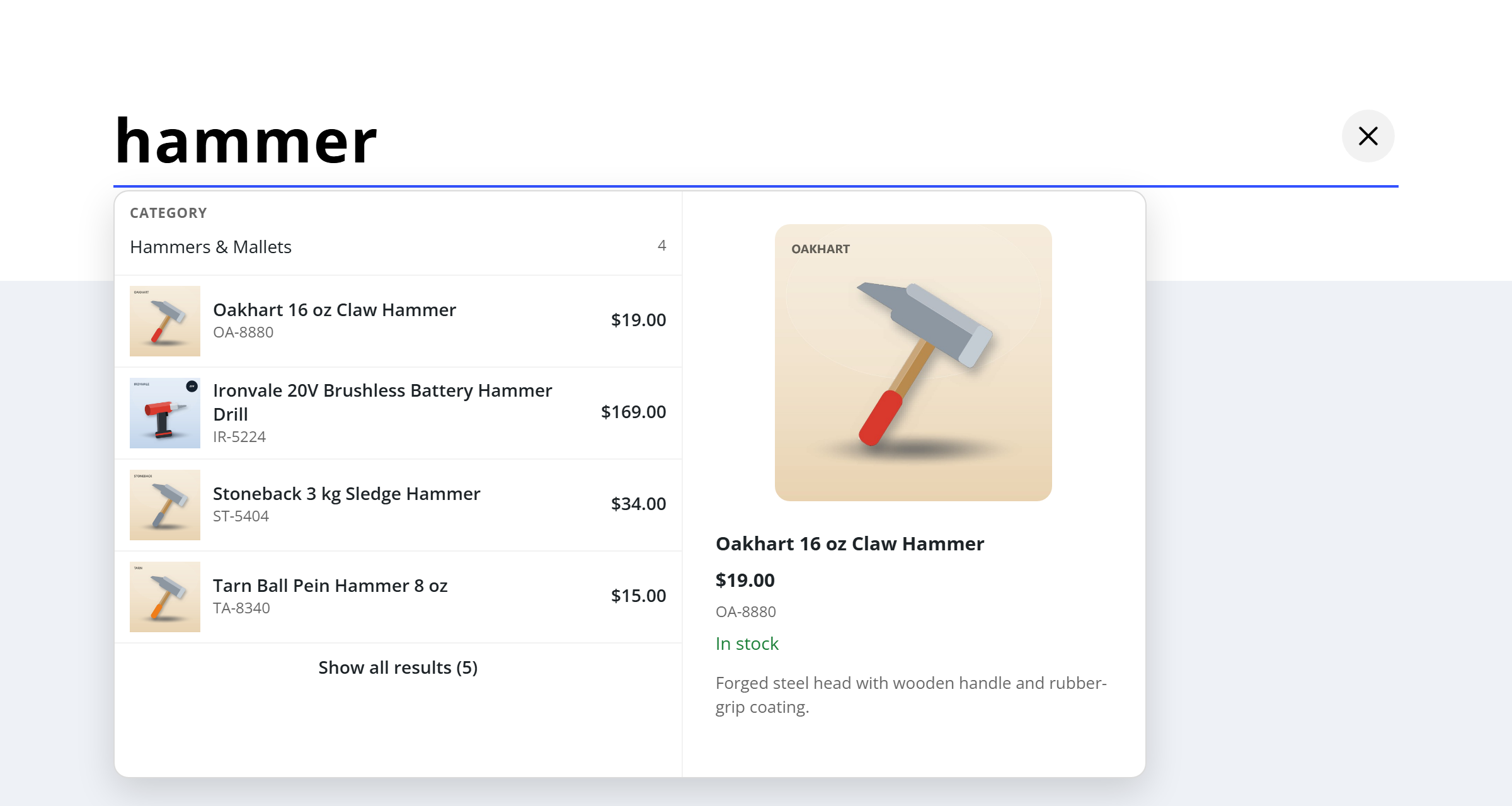
Point Searchmaker at your theme’s search input with one CSS selector. Shoppers get instant results with thumbnails, price, SKU, category and brand suggestions and an optional details panel. No template edits.
Pricing
Annual licenses, offline keys, 30-day money-back guarantee. Prices exclude VAT.
Instant results on the search box you already have.
179 €/ year
per site · excl. VAT
or 649 € once
30-day money-back guaranteeFull refund for any reason. How it works.Faceted filters and a Fast Grid shop archive.
219 €/ year
per site · excl. VAT
or 790 € once
30-day money-back guaranteeFull refund for any reason. How it works.Google Merchant feed with per-variation items, streamed in bounded memory.
119 €/ year
per site · excl. VAT
or 429 € once
30-day money-back guaranteeFull refund for any reason. How it works.Search, filters and feeds on one index.
449 €/ year
per site · excl. VAT
or 1 590 € once
30-day money-back guaranteeFull refund for any reason. How it works.Each yearly license is valid for 1 year. Keys work offline (no license server, no phone-home) and are tied to the domains you list. 30-day money-back guarantee. Sold to businesses only; prices exclude VAT. Prices exclude VAT.
Secure payment by Stripe
Card details go to Stripe and never touch our server. Apple Pay and Google Pay appear where your device supports them.

Questions
Something missing? Ask us. We would rather answer than guess. Weighing us against SearchWP or FiboSearch? Compare them fact by fact.
Yes, with limits. A query that is exactly a SKU or model number is matched first. Variation SKUs are searchable and lead to the parent product. A SKU is also indexed in its parts, split at hyphens and underscores, so a search for m18 finds m18-imuri, and the first letters of a word work as a prefix. What we have not measured: matching text from the middle of a code that has no separator, such as 8x40 inside M8x40-A2, on a real catalog. Check your own part numbers in the first 30 days; the money-back guarantee covers it.
The builder works in chunks and writes a new index version next to the live one. It is checked, then switched in with one atomic step, so a failed build never touches the live index and you can roll back. It also runs from WP-CLI and as a queued background rebuild. Measured: a synthetic catalog of 100,000 products with 165,264 variations built in about 6.1 s with a peak of about 57 MB (PHP 8.3, 128 MB, shared-style host). Not verified: a build from a real 100,000-product MariaDB WooCommerce database, and a rebuild driven by WP-Cron on a weak shared host. We do not promise it never fails on a small hosting plan.
Search ranks in tiers: exact SKU or model, exact words, prefixes, then typo-tolerant matching. Open synonym packs cover Finnish, English, Swedish, German and Estonian, and learning can add rules from searches that found nothing (anonymous, capped, off with one switch). The packs are generated data that native speakers have not fully reviewed yet, and we have not measured a zero-result rate on a real shop, so we do not quote one.
They are built not to. Filter controls are form elements, not links, so crawlers do not wander through combinations. Filtered URLs are noindex,follow and carry a canonical to the unfiltered archive (through WordPress core, Yoast SEO, Rank Math and All in One SEO), pages beyond the last one return a real 404, and you can optionally block filter URLs in robots.txt. We have not measured crawl statistics on a large shop.
By default every published variation becomes its own item with a g:item_group_id shared across the product, its own price, stock and image, and a link that preselects the variation. The file is static and requests never generate it. It is written on a schedule (manual, hourly, twice daily or daily) and after each rebuild, so prices are those at generation time, not real time. Limits: Google Merchant only, up to 500 variations per product, and colour, size, material and pattern attributes.
Instant search attaches to your existing search box through a CSS selector, so it works with classic and block themes without template changes. We verified it on a block theme, a classic theme and Salient with WPBakery. Diagnostics includes a compatibility check and suggested selectors for popular themes (treated as suggestions until verified on your site). Fast Grid replaces the main shop and category query; page-builder grids with their own queries are not replaced, but the [searchmaker_catalog] shortcode covers them.
The front end falls back to normal WooCommerce behaviour. Searchmaker is designed to fail soft: if the endpoint is unavailable or the index is unhealthy, shoppers still get results from WooCommerce while you rebuild.
It builds one index per language and is built for WPML and Polylang. Synonym packs are available for Finnish, English, Swedish, German and Estonian, and more languages are on the way (they are open data). TranslatePress-style setups are not supported yet.
Yearly licenses are subscriptions that renew until you cancel, and each renewal produces a new key. If a term ends without renewal there is a 30-day grace period in which the modules keep working with a warning in the admin; after that the licensed modules switch off and WooCommerce takes over. Nothing is deleted.
WordPress 6.5 or newer, WooCommerce 8.0 or newer and PHP 8.1 or newer with the sodium extension (included in standard PHP builds) for offline license verification. No Redis, no daemon, no shell access, no extra database.
OEM and platforms
The index behind Searchmaker is a plain PHP library with a standalone runtime. Put search, filters and feeds inside your plugin, platform or hosting offer, under your brand.
Install, build the index once, and try it on your own catalog. If it does not fit, the 30-day money-back guarantee covers it.